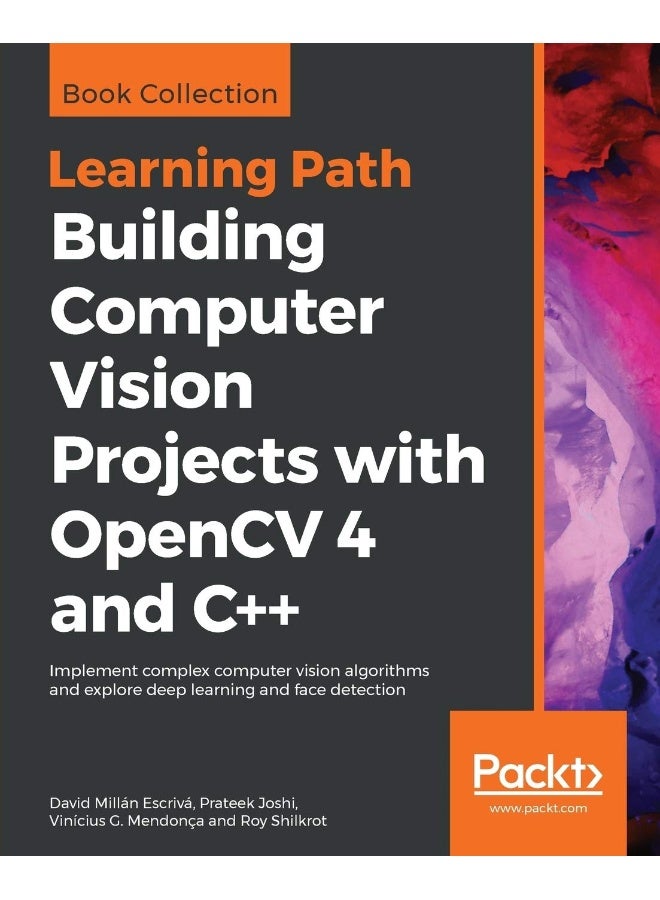
| عن المؤلف | David Millán Escrivá was eight years old when he wrote his first program on an 8086 PC in Basic, which enabled the 2D plotting of basic equations. In 2005, he finished his studies in IT through the Universitat Politécnica de Valenci with honors in human-computer interaction supported by computer vision with OpenCV (v0.96). He had a final project based on this subject and published it on HCI Spanish congress. He has worked with Blender, an open source, 3D software project, and worked on his first commercial movie, Plumiferos - Aventuras voladoras, as a computer graphics software developer. David now has more than 10 years of experience in IT, with experience in computer vision, computer graphics, and pattern recognition, working with different projects and start-ups, applying his knowledge of computer vision, optical character recognition, and augmented reality. He is the author of the DamilesBlog blog, where he publishes research articles and tutorials about OpenCV, computer vision in general, and optical character recognition algorithms.Prateek Joshi is an artificial intelligence researcher, an author of eight published books, and a TEDx speaker. He has been featured in Forbes 30 Under 30, CNBC, TechCrunch, Silicon Valley Business Journal, and many more publications. He is the founder of Pluto AI, a venture-funded Silicon Valley start-up building an intelligence platform for water facilities. He graduated from the University of Southern California with a Master's degree specializing in Artificial Intelligence. He has previously worked at NVIDIA and Microsoft Research.Vinícius G. Mendonça is a computer graphics university professor at Pontifical Catholic University of Paraná (PUCPR). He started programming with C++ back in 1998, and ventured into the field of computer gaming and computer graphics back in 2006. He is currently a mentor at the Apple Developer Academy in Brazil, working with, and teaching, metal, machine learning and computer vision for mobile devices. He has served as a reviewer on other Pack books, including OpenNI Cookbook, and Mastering OpenCV and Computer Vision with OpenCV 3 and Qt5. In his research, he has used Kinect, OpenNI, and OpenCV to recognize Brazilian sign language gestures. His areas of interest include mobile, OpenGL, image processing, computer vision, and project management.Roy Shilkrot is an assistant professor of computer science at Stony Brook University, where he leads the Human Interaction group. Dr. Shilkrot's research is in computer vision, human-computer interfaces, and the cross-over between these two domains, funded by US federal, New York State, and industry grants. Dr. Shilkrot graduated from the Massachusetts Institute of Technology (MIT) with a PhD, and has authored more than 25 peer-reviewed papers published at premier computer science conferences, such as CHI and SIGGRAPH, as well as in leading academic journals such as ACM Transaction on Graphics (TOG) and ACM Transactions on Computer-Human Interaction (ToCHI). Dr. Shilkrot is also a co-inventor of several patented technologies, a co-author of a number of books, serves on the scientific advisory board of numerous start-up companies, and has over 10 years of experience as an engineer and an entrepreneur. |
 استرجاع مجاني وسهل
 أفضل العروض